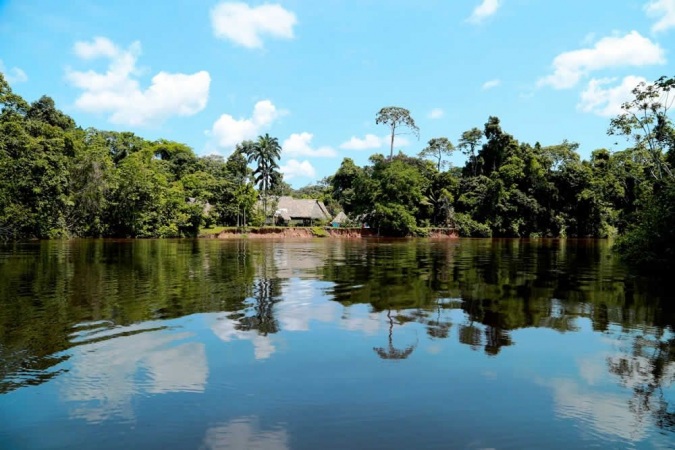
Our planet is full of beautiful and magical places, places that seem to come out of fairy tales, hidden paradises; And that is precisely what we will be discussing in this article. Our protagonist today will be a wonderful documentary that highlights the beauty of the Amazon jungle in the Waoraní community of Bameno, located in the Yasuní National Park in the Orillán province of the Republic of Ecuador.
In this beautiful piece produced by Vistazo magazine, we will be able to appreciate the natural wonders of this magical place, under the lens of photographer Manuel Aviles, who will also be the person in charge of transporting us to the Ecuadorian Amazon through his narration.
The Ecuadorian Amazon jungle functions as a refuge for native communities that still live like their ancestors, thus preserving their ancestral culture, such is the case of the Wao community of Bameno, who are children of the jungle and guardians of ancestral knowledge. They live in a symbiotic way with nature, which allows them a self-sustaining life, they are a community from which we can learn and enrich our conservation culture.
SPOILER ALERT! You will meet the last existing warriors of the Wao community and the oldest tree in the Amazon.
AMAZON: INCREDIBLE PLACE
It is an area characterized by the high frequency of rainfall, its relief is wrinkled approaching the western flanks of the Andes, but as it moves away they form a plain, this region receives tons of sediments that feed its channels and the soil with nutrients dragged from the range. This region is threatened by the colonization of land as well as the extractive oil industry causing an impact on the environment. The tropical humid forest in the Amazon is characterized by large trees, a canopy of up to 30 meters above the ground, characterized by species such as ceibas, chunchos and capironas, various tree species as well as other characteristics that provide food to various species of animals such as monkeys, squirrels, guanta, anteaters, which in turn are food for predators such as the harpy eagle, the jaguar, alligators, among other species.
NATIONAL PARK: Yasuní Biosphere Reserve
Now let’s talk about Yasuní; this term, without knowing its linguistic origin, means “sacred land” as it’s generally interpreted by communities in the area; The park extends over an area of 9,820 square kilometers in the provinces of Pastaza and Orellana between the Napo River and the Curaray River in the middle of the Amazon basin, about 250 kilometers southeast of Quito.
It’s the largest protected area in continental Ecuador, it protects an impressive biodiversity in the heart of the Amazonian tropical rain forest and protects part of the territory of the Waorani nationality. Surprising biodiversity figures have been reported in Yasuní for various groups of flora and fauna, never before recorded in any protected area. Here we find hundreds of species of trees, wide rivers that overflow with torrential rains and large animals such as the jaguar, the anaconda and the harpy eagle.
We also find very small creatures, such as the lion or pocket monkey, the smallest primate in the world, and a great variety of reptiles and amphibians that place this park among the most biodiverse in the world.
The human side of Yasuní is also full of surprises. Inside the park live the Tagaeri and Taromenane, Indigenous Peoples in Voluntary Isolation. To protect them and the biodiversity of Yasuní, the Tagaeri-Taromenane Intangible Zone was created in 1999. The Yasuní National Park, the Intangible Zone and the adjacent Waorani territory were declared a Biosphere Reserve by UNESCO in 1989.
CULTURAL ASPECTS: ancestral tribes, children of nature.
The entire area between the Napo and Curaray rivers was home to semi-nomadic hunter-gatherer peoples related to the Waorani culture and language.
The Waorani lived throughout the area, hunting, gathering fruits and maintaining small crops; in 1969 they were confined and grouped in an area called “protectorate”, located at the headwaters of the Curaray River.
The clans Tagaeri and Taromenane did not agree to live in the protectorate or give up their way of life are the seeds of the Indigenous Peoples in Voluntary Isolation. Today, to the west of the park extends the Waorani Territory, which covers only part of their ancestral territory, while the northern part of Yasuní is concessioned to several oil companies.
Other inhabitants of the park are indigenous Kichwa from the banks of the Napo River, who live north of the protected area, and an itinerant population of students and researchers who work in the two scientific stations that are located inside the park and in its buffer zone.
BIODIVERSITY: more species than in Europe and North America.
Yasuní is a biodiversity sanctuary. The investigations carried out in the last decade reflect impressive figures not previously recorded in any other area of tropical forest in the region and although the data may vary over the years, they give us an idea of what this national park is home to: more than 2,000 species of trees and shrubs, 204 species of mammals, 610 species of birds, 121 reptiles, 150 amphibians and more than 250 species of fish.

In one hectare of Yasuní, for example, 650 species of trees were reported, which represents more than those found in all of North America. The terra firme forest, the one that is not flooded, constitutes the main ecosystem of the park.
In the great green carpet of Yasuní there are trees that can reach 50 meters in height and with trunks of more than 1.5 meters in diameter. In addition to their extraordinary size, some, such as ceibos, sangres de gallina and canelos, form enormous roots that open in a triangle at the base of the tree. Others, such as dragon blood, caspi cross, chunchos and cacaos de monte, of equal or smaller size, lack these unique roots. Among the large trees we also find a group of plants that are very abundant in tropical forests: the palms. Chontas, chambiras, ungurahuas and pambiles are frequent.

Yasuní is home to 12 species of monkeys; There are from the largest, such as spiders, chorongos and howlers, to the smallest monkey in the world, the lion or pocket monkey. We also have the baby milk chichichos, named for their habits of sucking the sap of certain trees. Other mammals are the jaguar, the largest feline in the Americas, and the capybara, the largest rodent in the world. There are also pumas, Amazonian tapirs, anteaters, peccaries or wild pigs, and smaller mammals such as guatines, deer, tigrillos and cusumbos. Birds are another spectacular group. In large flocks the colorful macaws and parrots cross the skies. Toucans, sigchas, fly eaters, woodpeckers, nuthatches and a great variety of hummingbirds jump among the foliage of the plants. Trumpeters and tinamous walk on the ground. Deep green tree frogs with enormous eyes crouch on the branches of bushes and grasses; On the ground, under leaves and stones, are the tiny nurse frogs that take care of the laying of eggs. In the rivers and lagoons, such as Añangu and Tambococha, live pink dolphins, small gray dolphins, manatees and giant otters. Near the water there are countless herons, hoatzines and cormorants, as well as charapa turtles. In the rivers also lives the giant anaconda and a great variety of fish such as cachamas, paiches, palometas, bocachicos, catfish, sábalos and tucunaris.
It is truly magical how technology and the effort and work of people who take the time to make this type of documentaries can bring us closer to these beautiful and unknown places. Knowing a little about the way of life of these native peoples shows us that there are still unexplored places on the planet, where in addition to connecting with nature, we will have access to the culture of native peoples. Towns that currently also want to promote activist and conservationist tourism, since through tourism they can receive certain benefits such as education. We hope to share and enjoy this wonderful documentary with friends and family.