
Easter Island, also called Rapa Nui, is one of the most distant but also most fascinating destinations in the world: it’s the most isolated of the inhabited lands on the planet and can be reached by landing at the Mataveri International Airport (IPC), where only one plane a day arrives and departs. Many of its beaches are among the best beaches in Chile. In this article we will be talking about hidden paradises in Easter Island.
Tahai (Ceremonial Complex)
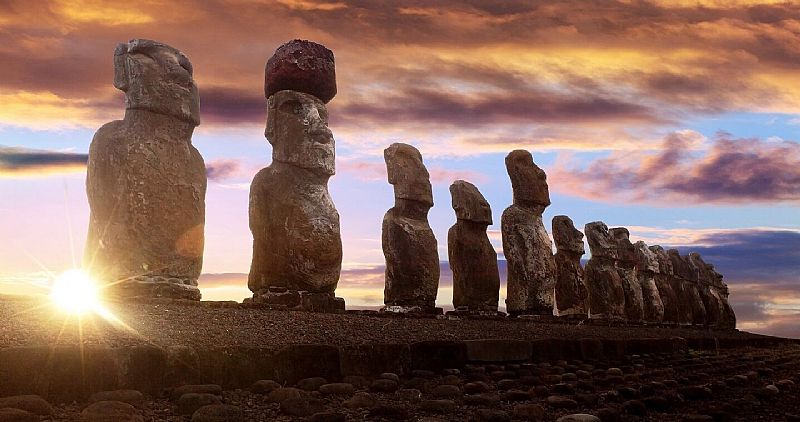
It is a ceremonial complex that also includes Ahu Tahai, Ahu Vai Uri and Ahu Ko Te Riku and was completely restored in the 1960s. We find houses, corrals, ceremonial places, platforms and even a stone ramp to launch boats. Several burial chambers built for community leaders have been identified, such as some houses in the shape of overturned boats and used by the elders of the community. It was estimated that about 200 people lived here, although most used the nearby caves and other rock shelters.
Undoubtedly, the great attraction of Tahai is its three Ahu (ceremonial platforms) located on the small rocky cliff overlooking the sea: the altars stand out against this magnificent backdrop.
From the Sebastiana it is possible to get an idea of how steep Valparaíso is and get a good view of the city. Just outside the house-museum there is a fair, with many craft and souvenir shops.
Ahu Akivi (ceremonial platform)
It is for various reasons, an archaeological site with very peculiar characteristics, based on the precise restoration work (it was the first platform to be restored in 1960).
It is located on the southwestern side of the Maʻunga Terevaka volcano, the highest point on the island, where Ana Kakenga, the cave of the two windows, is located.
The fact that it is located inland is already significant, since most of the ceremonial platforms are located along the coast of the island and, moreover, it is the most elaborate. These are crematoria for funeral ceremonies.
In addition to the crematorium to the structure, seven moai statues were erected on the central platform.

Rano Raraku volcano
The volcano was formed 300 thousand years ago, it has a height of 160 meters.
Here the moais were carved and then taken to the “ahus”, the ceremonial platforms, along the entire coast. Dozens of stone heads stand out against strange figures carved into the rocky surface of the mountain.

Orongo (Archaeological site)
The ceremonial village of Orongo, which means “The Call”, is one of the most spectacular sites on the island. It is located south of the Rano Kau volcano in the strip that separates the crater from the lagoon and the cliff that descends towards the sea. The village was inhabited by tribal leaders and the first Orongo stone houses appear to have been built around the 1400s.

Vinapú (Archaeological site)
Vinapú is how the southwestern coastal area of Rapa Nui is known. It conserves two ahu platforms, that of Vinapu and that of Ahu Tahira, both with statues of moais and pukaos from the most recent period.
Ahu Tahira represents the best example of rock engineering on the island, where stone blocks were shaped and then brought to the site instead of being adapted to the natural shape of the rocks.

Poike volcano
The Poiké Volcano Peninsula is famous for its gigantic stone statues (more than 600) and the ruins of gigantic platforms built in three different cultural periods. They go back to the first two, Tahai and Vinapu, admired and described by the English Captain Cook. The volcanic tube and Ana or Keke, on the other hand, remained hidden until 1987.
Maʻunga Terevaka volcano
Maʻunga Terevaka is the highest point on the island, at 511 meters high offering a 360 degree panoramic view of the island surrounded by the vastness of the Pacific Ocean. In the past, on the undulating slopes of the volcano there was a vast vegetation and also a large population.
Anakena Beaches
To get there you have to take a small path along a hill full of palm trees. Very fine and clear
sand that at some moments of the different seasons takes on a pink color. Always gentle waves, favorable water for diving. There are also ahus with moais.
Islet of Motu Nui
The absence of plankton and the substantial lack of pollution make the Motu Nui islet environment particularly suitable for diving and snorkelling. The waters are clear and transparent and the temperature, which ranges between 18 and 26ºC, makes it an unforgettable experience.


