
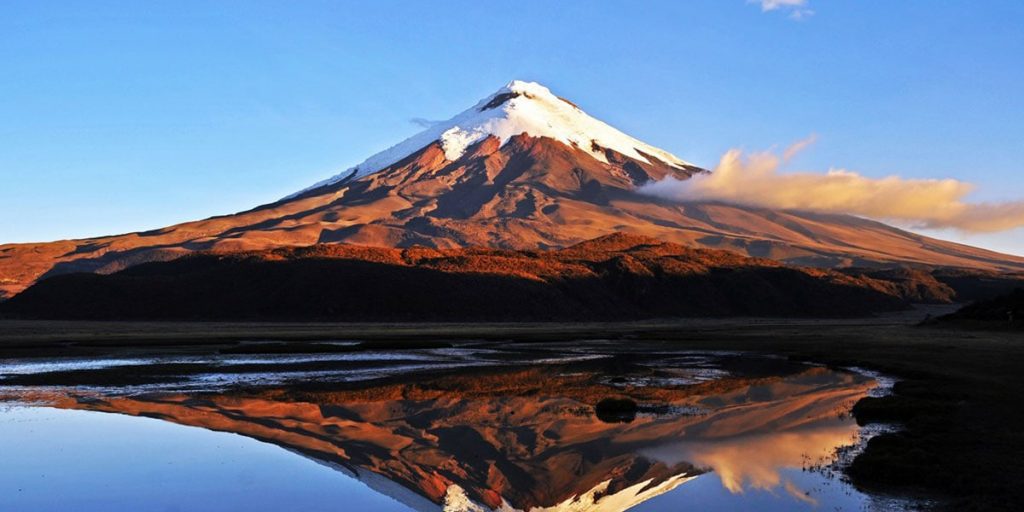
The volcano is one of the Hidden Paradises of Ecuador
It has to be the volcano. Although we have the ambition to talk about everything exemplary of other affinities and activities, we could not stay away from what many consider the most beautiful crater in Ecuador, which is located in the southeastern area of the capital, Quito. Its perfect symmetrical cone is somehow irresistibly pleasing to the naked eye, fulfilling our preconceived idea of what a crater should look like.
The city of Cotopaxi towers at an astonishing 5,900 meters above sea level. But it is not the highest in Ecuador. That dignity falls to Chimborazo further to the southwest, but still it is surprising, as snow usually starts to cover it above 5,500m. After an exclusively cold darkness, the snow avalanche manages to reach its greenest platform.
It is often said that the way to a traveler’s heart is through his belly. With this in mind, our secondary cognition to greet this jurisdiction is the local dish called chugchucaras. As it is to be esteemed in the Andes, being a compliment to the pig. Their dish will arrive overloaded with fried pieces of pork simmered for hours in its own fat. Plus weet empanadas empanadas, fried potatoes in the same pan as the pork, fried sweet ripe plantains, roasted corn and, of course, burstado.
The Incas, Cotopaxi
It is a little credited, but very transcendental fact, that the domains of Cotopaxi have an energetic link with the Inca past of the region of Ecuador. The imperialist Incas were not only retained from their northern expansion by the populations that inhabited the region for years. However the last Inca Emperor, Atahualpa, subdued these lands. Not only that, the brand new archaeological and historical exhibits have signed the area of Malqui Machay from the western zone in the town of Sigchos.

Lake Quilotoa in Cotopaxi, Ecuador
At the top of the Andes, on the west side of the Panamerican Highway, and accessible by a large asphalt road, you will find an effective vision to contemplate, imagine a vast orifice, an old volcano that exploded with such ferocity that only its spots remain, full of fresh water with a color that changes assiduously due to the light.
This is the Quilotoa Lake of Cotopax a Hidden Paradises of Ecuador, it is a playground for adventurers, manage to march from the margin of the orifice to the water’s edge and promptly paddle its glassy area in a kayak, hike on horseback in the vicinity or opt to walk the contour of the crater rim in about five hours. Or, alternatively, you can hike to the rim, rest and enjoy the view. There is a surprising new research stand at Quilotoa, which is located on the western side of the town that has blossomed to welcome tourism.

Cotopaxi Art Street in Cotopaxi, Ecuador
Although its beginnings go back only a generation, one would have thought that experts in this area have been painting in the naïf style of the small town of Tigua for centuries. The practice of painting, we believe it now deserves that pseudonym, began with J. Toaquiza and has now developed to numerous pieces in his lineage and beyond. The paintings, painted on canvases made of leather, embody an Andean world clogged with festivals, daily life, political agendas and mythological minutes, all in sailboat.
No visit to this region is consummated without buying a stranded cap from a stall somewhere. Because of the elevations, it feels cold the instant the sun goes down, so it is an accurate purchase to keep your head and ears warm.


