
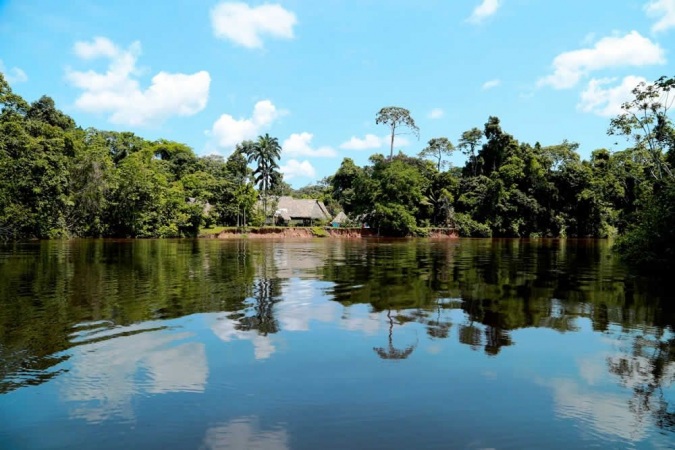
Sucumbíos: paradisiacal province. Do you want to travel to a new magical place? Don’t miss this article of the top of hidden paradises of Ecuador located in Sucumbíos!
The Province of Sucumbíos is located in the north of the country. Right n the geographical line accredited as Amazonian zone, especially in the external flanks of the western highlands in the west and the wide Amazonian plain to the east. Its functional capital is the town of Nueva Loja, which is also its largest and most populated city. It covers a territory of about 18,812 km², being the fourth largest jurisdiction in the country, behind Pastaza, Morona Santiago and the city of Orellana. Visit the 4 Tourist Places in Sucumbíos.
In the territory of Sucumbios reside 176,572 people, being the seventeenth most developed of the country and the most increased of the Amazon. The Jurisdiction of Sucumbíos is made up of 7 corners, with their corresponding urban and rural piles. According to the last territorial classification, the jurisdiction of Sucumbíos will concern a region also comprised by the jurisdictions of Imbabura, Esmeraldas and the Carchi region, although it is not legally conformed, designated North.
It is one of the most significant producing, mercantile, banking and lucrative centers of the Amazon. As well as one of the main provinces that supply the Ecuadorian State with the hydrocarbon that is sent. The main activities of the jurisdiction are oil extraction, trading and agriculture. The sale and purchase on the border, which commercially and touristically connects all of Ecuador and Colombia, the borders are undergoing a strong change.
Sucumbiense jungles in such, Ecuador

The Sucumbian forests are the origin of 4 indigenous races of the Amazonian region of Ecuador, the Cofan, the Quichua, the Secoya and the Siona. It had different migratory phases derived as the toucans and encabelladas. The Hispanic colonization was given with the Spanish institution, during that stage the maximum reality and predecessor of the jurisdiction would be the Government of Mocoa and Sucumbíos. After the independence war and the union of Ecuador to the Great Colombia, the Jurisdiction of Pichincha was established in 1824, in which within its terms was the current department of Sucumbios, immediately became a fragment of the great Jurisdiction of Oriente, later would become part of the Jurisdiction of Napo de Pastaza and quickly of Napo. In 1989, the country’s twenty-first jurisdiction, the Jurisdiction of Sucumbíos, was established.
Limoncocha Lake, Sucumbíos

Called years ago as Capucui. It is related to a real lake, created by an old extremity of the Napo River, obstructed hundreds of years ago by alluvial domains and consecutively covered by vegetation until it changed into a mysterious jungle. There is also a smaller lake with the same particularities and another one known as Yanacocha or Laguna Negra, due to the color of its waters.
Cofán in Sucumbíos, Ecuador

Patrimonial population of the Amazon, they self-establish themselves as A’i which in their special dialect means people and currently represent a group of a thousand natives living in the Ecuadorian and Colombian department. The usual organization is based on patrilineal or “antia” class collections. The role of cacique or tuturica known as chief and shaman is definitive, both at the faithful and political level.
Limoncocha Biological Reserve in Sucumbíos, Ecuador

It is one of the places in Ecuador that offers the greatest diversity of mammals and exuberant number of genera of amphibians, birds and reptiles, including two crocodiles, the popular black caiman and the magnificent spectacled caiman, turtles and lizards. It is an environment of great hierarchy mainly because it contains flora and fauna of great scientific value. From here you can enjoy the Laguna Negra-Yanacocha, it is located on the drainage of the Limoncocha lagoon towards the Capucuy, in an almost unknown area because it is covered with dense flora. It is believed that numerous anacondas exist in this sector and that it is favorable territory for caimans to live.


