

Ecuador more than makes up for its small size with an array of indigenous cultures, colonial architecture, scenic Ecuador makes up for its compact size with a combination of indigenous cultures, colonial architecture, beautiful landscapes, and dense rainforests. It is one of the most beautiful countries in South America. Ecuador borders Colombia, Peru and the Pacific Ocean on the continent’s west coast. It is no bigger than most of the states in the United States. This beautiful country of around 18 million inhabitants attracts tourists from all over the world for countless reasons. For nature lovers, Ecuador’s lush and ecologically significant forests are a big draw.
For outdoor sports enthusiasts, there are endless climbing and hiking adventures to participate in. Ecuador’s pristine tropical beaches are some of the best in the world. Wildlife watchers will also gravitate toward its famous Galapagos Islands. And for sun lovers? Ecuador’s pristine tropical beaches are among the best in the world.
Once part of the Inca and, later, Spanish empires, Ecuador continues to show many influences from both groups. These lasting influences are perhaps most notable in the rich culture of its people. The impressive colonial architecture of the capital Quito, many of which have been declared UNESCO World Heritage Sites.
Make sure to check our top 5 of places tourists should visit in the coast of Ecuador:
The Galápagos Islands
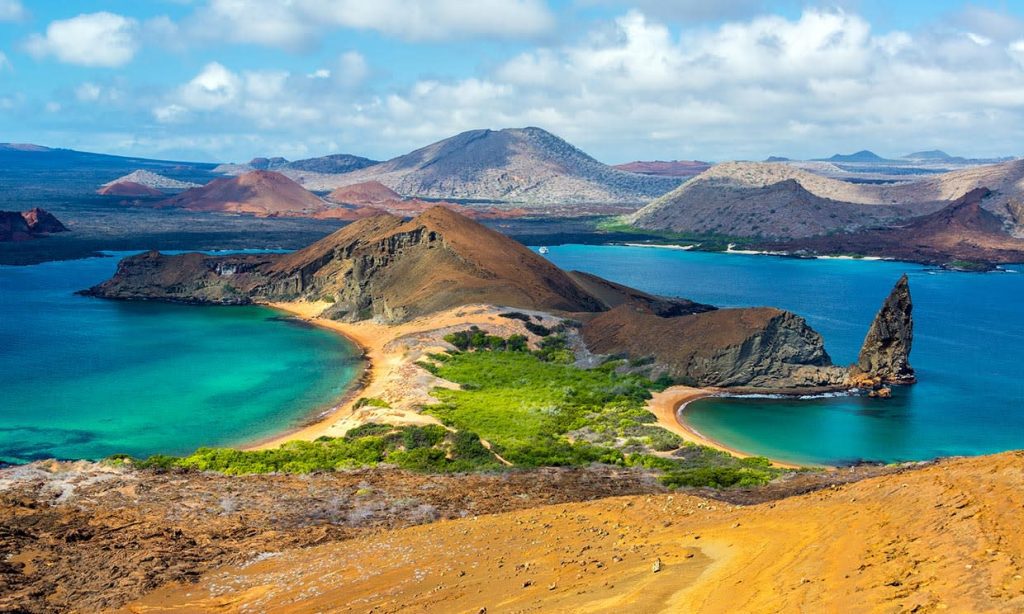
Since the “discovery” in the 16th century, the Galápagos Islands have been a source of interest and inspiration for visitors from all over the world. Named for the islands’ giant tortoises, this UNESCO World Heritage Site is home to a unique ecosystem. It has evolved largely without outside influence (mainland Ecuador lies some 1,000 kilometers to the east). Consequently, a visit to this unspoiled region offers an exceptional opportunity for wildlife observation. Here you can see a variety of rare creatures both on land and in the surrounding sea.
The Galapagos Islands remain one of the most active volcanic regions in the world, and island formation is still ongoing.
Not surprisingly, a visit to this fragile ecosystem can only be made as part of a guided tour of the designated sites. However, there are not one or two areas that visitors can access without a guide. These nclude some areas popular with scuba divers.
The main attraction is the many rare bird species in the area, 28 of which are unique to the islands. These include the Galapagos penguin, flightless cormorant and waved albatross, as well as 13 species of Darwin’s famous finches.
Tip: If you are lucky enough to make it to the Galapagos Islands, be sure to book a visit to the Charles Darwin Research Station. The same is located in Puerto Ayora on the island of Santa Cruz. Visits to this important research center can be made prior to your arrival and are well worth the effort.
Quito: Ecuador’s Historic Capital

Situated high in the Andes, Quito, the capital of Ecuador is filled with well-preserved examples of colonial architecture. It is the largest historic center in South America. This city is a UNESCO World Heritage Site because of its many old churches. Of course, we must not forget the beautiful squares and first-class museums. 1.6 million people have long been a favorite of artisans. This is a great place to shop for local arts and crafts, from ceramics and wood carvings to colorful clothing.
The most famous attraction in Quito’s historic center is the Church of San Francisco, in Plaza San Francisco. Twin Twin Towers on each side of this huge premises. Highlights include its splendid baroque interior and the Museo del Convento de San Francisco. It charge your religious pictures, carving, statues, porcelain, textile and furniture manually.
The journey of other beautiful churches belong to Jesus. It was built at the beginning of the 17th century and was listed as one of the world’s most important buildings by UNESCO. Also attractive Keto Cathedral, which was built in the 1560s in the 1560s.
One of the best things in Quito is searching for Grande Plaza. This beautiful square is surrounded by many important points of interest. Some of them are the cathedral, the Presidential Palace and the Archbishop’s Palace.
Cuenca

The beautiful city of Cuenca – officially known as Santa Ana de los cuatro ríos de Cuenca – is located in southern Ecuador. With some 660,000 inhabitants, this picturesque city is a charming place to visit and explore on foot. Declared a UNESCO World Heritage Site, the city is brimming with splendid colonial influences and architectural treasures spanning 400 years and including Spanish and indigenous elements.
The historic center of the city is also the site of many of Cuenca’s main attractions, one of the most important being the Old Cathedral of Cuenca (Iglesia del Sagrario). Built in 1567 with stones from a nearby Inca building, it houses an ancient organ dating back to 1739, a 1751 bell tower, and a museum of religious art.
The impressive Cuenca Cathedral is also worth a visit. Built in the 1960s, its three beautiful blue-tiled domes are hard to miss. Also worth seeing is the Church of San Sebastian, with its mix of Gothic and neoclassical elements.
While strolling through Cuenca’s pleasant narrow streets, be sure to spend some time exploring the many plazas and parks. The best place is Parque Calderón in the heart of the old town. Plaza de San Blas dominated by the Church of San Blas; and Plaza de San Francisco, where merchants sell textiles and other products.
Cotopaxi and Cajas National Parks Ecuador

Two of Ecuador’s most popular national parks, Cotopaxi and Cajas, are within easy driving distance of the cities of Cuenca and Quito and make great day trips. Of the two, Cotopaxi National Park is the best known, just 50 kilometers south of Quito.
The highlight of this visit is the opportunity to see many volcanoes up close. The most notable is the massive (and still active) Cotopaxi volcano. Last erupting in 2015, this massive volcano, along with the smaller Rumiñawi and Sincholagua, dominates the stunning landscape of the area.
About 30 kilometers from Cuenca, in the stunning Ecuadorian highlands, Cajas National Park offers a very different experience due to its many hills and valleys, making it a perfect place for hiking and biking. With over 270 lakes and glacier-rich lakes, it is also enjoyed by water sports enthusiasts, especially rowers and rowers.
Finally, the Podcalps National Park, often referred to as the “American Botanical Garden,” has a diverse collection of flora and fauna. Located in the southeast of the country, its humid mountain forests are home to more than 4,000 species of plants and trees. Some of these specimens, such as the famous eucalyptus and Ecuadorian country trees, reach a height of 40 meters.
La Naríz del Diablo: Ecuadorian Devil’s Nose

A visit to the breathtakingly beautiful Devil’s Nose should be on everyone’s bucket list. Whether you are a train enthusiast Visiting the amazing “devil’s nose” should be on everyone’s priority list. Whether you are a train, the best way to see this beautiful area of Andes Mountain near Alaisi City, is one of the largest railways in that country.
The 12-kilometer round trip to the Devil’s Nose is undoubtedly one of the most popular. This is part of the most beautiful location of the entire country. Highlights climb a slope close to the mountains on the observation deck at the top, so it has a beautiful tourist destination on a train that zigzag runs through a series of switchbacks.
Along the way you get the chance to experience the rich culture of Andes. Highlights include visits to Condor Museum. You can browse exhibits and exhibits related to the indigenous peoples of the area.


